
You receive recurring questions or requests through different channels.
Agents that get things done, with clear rules.
We design self-management agents that consult information and perform tasks within a defined scope. They can handle enquiries, organise requests or assist an editorial process, asking for human involvement when needed.
What is a self-management agent?
It is a system that combines conversation, information and actions. Unlike a chat that only answers questions, it can connect to tools to move a process forward. Its permissions, limits and when it should turn to a person are defined first.
Customer support and scheduling depend on manual exchanges.
A process needs to retrieve context and prepare information consistently.
FROM IDEA TO SYSTEM
Examples that make it clearer.
EXAMPLE / 01
L.E.O.
From the first question to the next action.
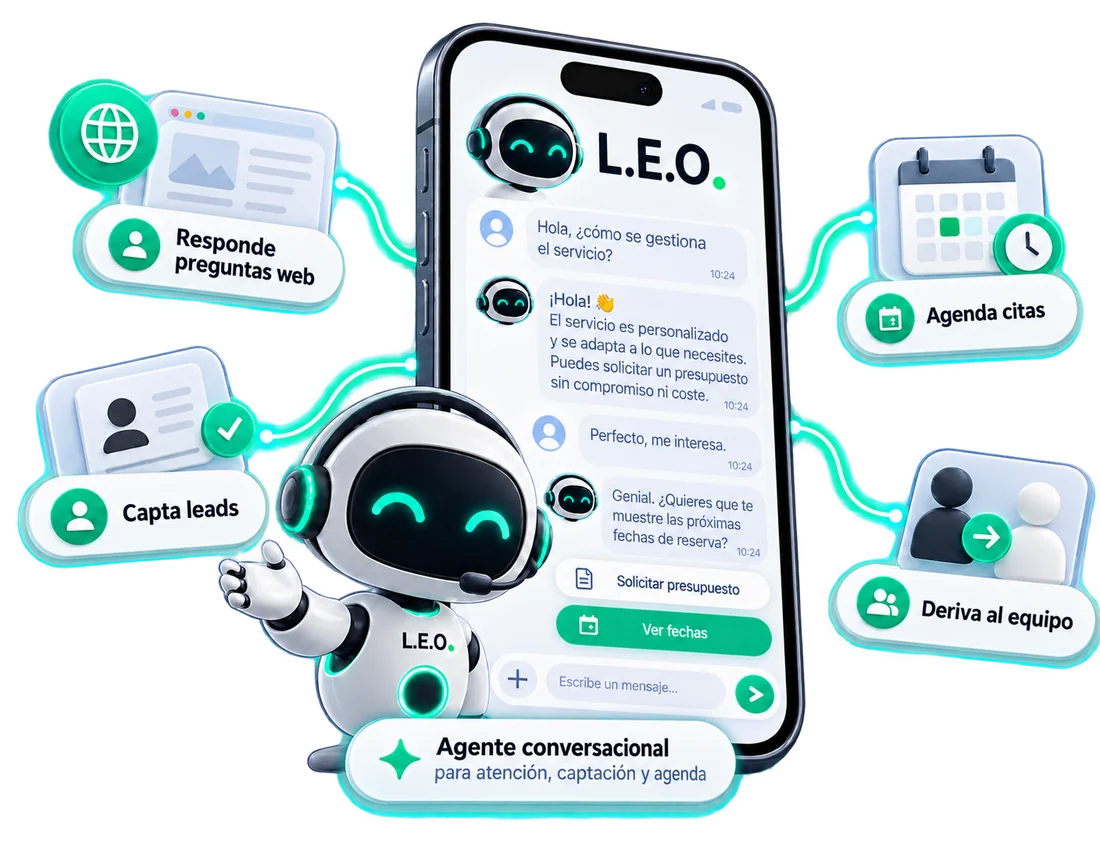
L.E.O. stands for Linguistic Execution Orchestrator. It was created for the website of a business that operated by appointment, to inform customers about its services and help them book appointments.
The problem
An enquiry may go unanswered, an opportunity may be lost or a booking may require too many exchanges.
The approach
An agent that answers using the service information provided, collects the necessary details, checks scheduling options and refers to the team when required.
- Answers to questions about services
- Lead capture and organisation
- Availability checks and scheduling
- Referral to a member of the team
Answers, actions and referral criteria are defined before connecting the agent to the business tools.
EXAMPLE / 02
D.A.N.I.
An editorial assistant with context.
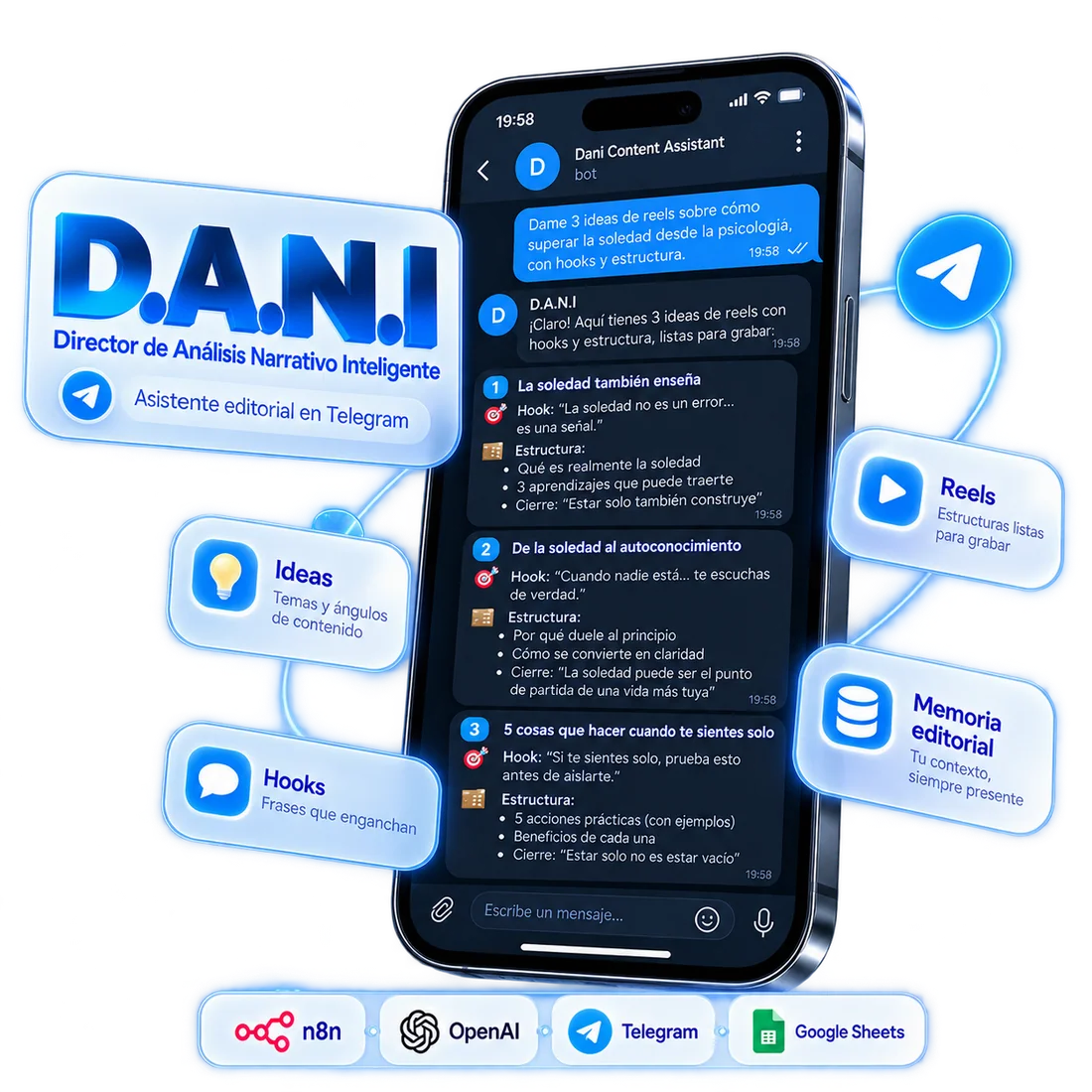
D.A.N.I. —Director de Análisis Narrativo Inteligente— was created to help a content creator generate topics and develop scripts for their posts. It works as an editorial assistant in Telegram, suggesting ideas, angles, hooks and structures to develop.
The problem
Starting every piece of content from scratch and retrieving editorial context from earlier conversations takes time and scatters ideas.
The approach
A conversation that retains editorial context and returns organised suggestions. The workflow shown connects Telegram, n8n, OpenAI and Google Sheets.
- Content ideas and angles
- Hooks and narrative structure
- Reel suggestions ready to develop
- Editorial context and memory
Suggestions are working material: final review and editorial decisions belong to the person responsible.

EXAMPLE / 03
S.A.R.A.
A calendar that answers the phone.
S.A.R.A. (Sistema de Atención, Reservas y Agenda — Care, Booking and Calendar System) is an AI voice assistant for businesses that work by appointment: it answers calls, checks the real calendar, books, moves or cancels appointments and, when it cannot resolve something, leaves a note for the team.
The problem
The phone rings when nobody can pick it up, and every unanswered call is an appointment that never gets booked.
The approach
A voice assistant that answers naturally, checks real availability, confirms the details before saving and hands over to the team when it cannot resolve something.
- Book, move and cancel appointments by voice
- Information on opening hours, services and prices
- Notes for the team when it cannot resolve something
- Designed for Spanish, Catalan and English
The demo is a real recording with fictitious data. The assistant only acts within the rules and the calendar defined for each business.
The process comes first.
Then the technology.
Define the task
We agree on what the agent can resolve and what is outside its scope.
Connect the context
We define information sources, tools and permissions.
Test the exceptions
We review errors, ambiguous cases and referral criteria.
FREQUENTLY ASKED QUESTIONS
Questions worth answering.
Is an agent the same as a chatbot?
Not necessarily. A chatbot may only converse. An agent can consult tools and carry out authorised actions within a defined process.
Can it schedule appointments?
Yes, when connected to a calendar with rules for availability, required details and confirmation. L.E.O. illustrates this use case.
What happens if it cannot resolve an enquiry?
It should follow a defined referral process and request human involvement, rather than invent an answer or perform an action outside its scope.
Does D.A.N.I. publish content without review?
The example focuses on ideas, hooks, structures and editorial context. Final content decisions and review belong to the person responsible.
What is S.A.R.A.?
S.A.R.A. (Sistema de Atención, Reservas y Agenda) is an AI voice assistant for businesses that work by appointment. It answers the phone with a natural voice, checks the real calendar, books, moves or cancels appointments and, when it cannot resolve something, leaves a note for the team.
Can S.A.R.A. book appointments by phone?
Yes. It asks for the service and the day, checks the real slots in the calendar, offers two or three options, repeats the details (name, phone number, day and time) and only saves the appointment once the person confirms. Two calls cannot book the same slot.
Can it connect to my calendar and my phone line?
The connection is defined with each business. On the phone side it can be call forwarding (for example, only when nobody answers or outside opening hours) or a direct connection to an IP switchboard. For the calendar it can use S.A.R.A.’s own or connect to other systems through an API or automations; if the system does not allow it, S.A.R.A. takes the request and a person confirms it.
Does it say it is an AI, and is the call recorded?
Yes, at the start it introduces itself as an automated assistant. In its current configuration the audio of calls is not saved, and each business’s data is kept separate.
What does S.A.R.A. do when it does not know the answer?
It does not make things up. It says so naturally, asks for the name and phone number and leaves a note for the team with the reason, so they can call back.
THE NEXT STEP
LET’S TALK ABOUT THE PROBLEM Let’s talk about what you need to build.
You don’t need to arrive with a solution. Tell us about the process, the difficulty or the idea, and we’ll start there.