
An English version of your website should let visitors understand the service and get in touch in that language. Check content, language switcher, forms and follow-up messages, as well as the technical signals for search engines. Translating the menu is not enough if the enquiry falls back to Spanish or the English page has no accessible address of its own.
The visitor understands the offer, clicks to book and finds instructions in a language they do not know. The translation exists, but it stops just before the decision that matters. A multilingual website is tested as a journey, not by counting how many pages have an EN button.
Imagine a small interior design studio that works with foreign property owners. The same enquiry can start from a search in English or from a shared link. This is a hypothetical example. The studio does not need to promise service in every country: it needs to explain precisely what it offers, where it works and how the conversation will continue.
Which parts should you translate before expanding the content?
Start with the path that lets someone assess your service and ask for information. Include the explanation, the relevant conditions, the contact step and the confirmation messages. A sales page and its next step form one unit. It is better to complete that set than to translate many posts and leave the main action half done.
A useful translation preserves meaning and adapts the wording for the audience. Review professional terms, examples and expressions that do not work the same way in English. If you use an AI tool for a first draft, a human review is still necessary: fluent text can change the scope of a service or introduce a promise you never made.
In the hypothetical studio, the visitor needs to know whether you can coordinate a project remotely and in which area you offer on-site support. That information must match in both languages. Do not add international coverage just because you have translated the site. The language of the content does not by itself extend the business's capacity.
Prepare a short list of pieces that will be published together. Mark the ones that are missing and decide what path to offer until a translation exists. A link to the English index can help people keep browsing, but do not present it as the exact translation of an article that still exists only in Spanish.
How should the language switcher work?
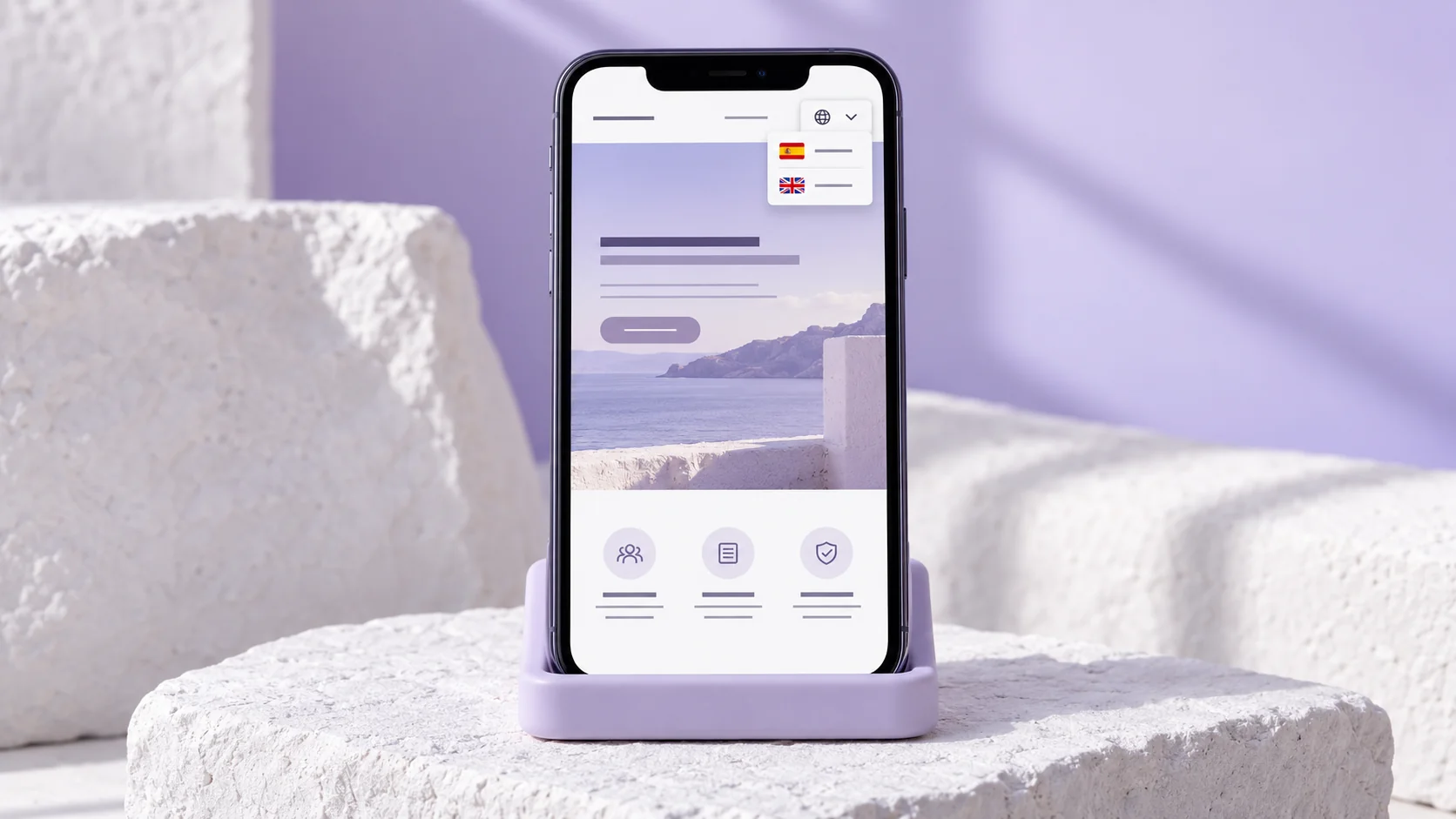
The switcher has to be easy to find and clearly describe the option available. Language names tend to avoid the ambiguity that a flag introduces: English and Spanish are spoken in many places. The article's illustration shows a language control; flags do not replace an understandable label in a real implementation.
When an equivalent version of the page exists, switching language should take the visitor to it. If it does not, the behaviour should be clear and predictable. A silent jump to the home page can make people lose their place, especially if they were comparing specific information before getting in touch.
Google's guide to multi-regional and multilingual sites, accessed on 11 October 2026, recommends separate addresses for the versions and warns about navigation based only on automatic adaptation. It is a technical reference; it does not show that a translation will receive visits straight away.
Let the user stay in control. Automatic adjustment may not match what they need: someone with an English-language browser may want to read Spanish. Check directly shared links too. The page must make sense from its own URL, without depending on having passed through the home page first.
What do hreflang and the canonical URL tell search engines?
Hreflang links versions of a piece of content aimed at different languages or regions. The canonical URL points to the preferred version among duplicate or similar content. They are not interchangeable instructions. A review should check both signals against the content that is actually served, without copying tags from an earlier template.
Google explains in its documentation on localized versions, accessed today, that alternates must be identified consistently and that links between versions need to be reciprocal. Do not declare a page as equivalent if it covers a different topic just to complete a list of languages.
An English page about renovations and a general Spanish home page are not necessarily an equivalent pair. Prepare a map of correspondences: which pages have a translation, which do not and how navigation will work for them. That map helps development and avoids promising alternatives that are still pending.
The same guide separates alternate markup from detecting the language of the text. So adding a tag does not turn a Spanish page into an English one. The main content must be in the language you announce. Review titles, descriptions and any elements the template may pull in from another version.
Do not read these signals as a guarantee of rankings. The usefulness of the content, its accessibility and many other factors play a part. The aim of the check is that the site does not send contradictory instructions and that search engines can recognise the versions you have actually prepared.
How do you test forms, bookings and replies?
Make a fictitious enquiry from the English page using a controlled inbox. Read the whole form, including errors, consent where it applies and the confirmation. Check what the team receives and what the visitor receives. The language of the entry point should carry through the process, if that is how you designed the service.
For a booking, check the date, duration, time zone and location. A translated button does not show that the calendar or the email are translated. If an external provider forces a different screen or template, identify that limitation before announcing a fully English experience.
For an AI assistant, the test needs more than a greeting. Try a common question, a request it cannot handle and the handover to a person. Check whether it keeps the language and describes the services with the same scope. An answer in English does not prove that the follow-up action also works in English.
- The enquiry must reach the agreed destination and keep its context.
- The confirmation has to explain what will happen next.
- The booking must show its essential details correctly.
- The team needs to know the requested language to continue the conversation.
Avoid using real customers' personal data in tests. If the journey includes external services or the handling of personal information, review their configuration and terms. This is general information, not legal or professional advice. Translating a notice does not by itself settle every obligation in the process.
Who keeps the two versions aligned?
The English version can fall out of date when someone changes a service in Spanish. Define a person responsible and a list of content that must be updated together. Do not rely on remembering which pages had translations when you are finishing another change. Matching versions need editorial maintenance.
Decide which changes require immediate translation: service scope, availability, contact instructions or relevant conditions. A minor style tweak can have a different priority. That distinction avoids publishing contradictory information while waiting for a general review of the whole site.
In the interior design studio of the example, changing the on-site working area affects the decision to hire. The English version should not keep showing the old area. Keep the date and status of the review in an internal record; do not invent an update date in the article to make it look recent.
Review shared elements too: navigation, footer, links and the text of external tools. When you publish a new page, check its address and its counterpart before adding it to the switcher. A small review per change is usually easier to manage than waiting until the two versions have drifted completely apart.
How have we approached it at meiika?
meiika presents the creation of websites and Growth & MarTech services. From that approach, language can be studied together with the commercial journey, the page structure and the way enquiries are measured, rather than reduced to a button in the header.
We do not attribute ranking results to this guide, nor a success story to the hypothetical studio. To assess your website, we would need to review the available content, the connected providers and your team's capacity to respond in English. Publishing a useful translation and keeping it up to date is part of the proposal, not a promise of immediate traffic.